from paul joseph watson & alex jones: The move to shut down and regulate the Internet under a new government-controlled system has accelerated into high gear with the announcement that the government’s cybersecurity strategy revolves around issuing Internet users with ID “tokens” without which they will not be able to visit websites, the latest salvo against web freedom which, in combination with Senator Joe Lieberman’s ‘kill switch’ bill, will serve to eviscerate the free Internet as we know it.
Under the guise of “cybersecurity,” the government is moving to discredit and shut down the existing Internet infrastructure in the pursuit of a new, centralized, regulated world wide web.
The strategy revolves around, “The creation of a system for identity management that would allow citizens to use additional authentication techniques, such as physical tokens or modules on mobile phones, to verify who they are before buying things online or accessing such sensitive information as health or banking records,” reports the FInancial Times.
Only with this government-issued “token” will Internet users be allowed to “able to move from website to website,” a system not too far removed from what China proposed and rejected for being too authoritarian.
from guardian: The internet could soon have its own red light district after the ".xxx" suffix was approved – though pornography companies are not keen to use it.
It marks the closing stages of a 10-year battle by ICM Registry, now run by the British internet entrepreneur Stuart Lawley, to get the .xxx domain set up so that legal pornography sites can be found in a single grouping...
That would mean that sex sites could be more easily filtered out from web searches, and lower their revenues. Free speech advocates also worry that sites about topics seen by US conservatives as controversial, such as homosexuality, might also be forced to use the .xxx suffix...
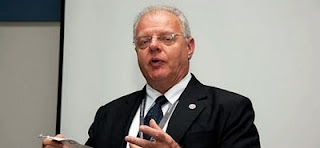
"I want to make sure that the computer on the other end knows that it's me that's interacting with it," he told audience members of the Symantec Government Symposium 2010.
Rather, it will propose a common identification standard for members of the public, who would utilize it while accessing electronic health records, conducting online banking, shopping online or even just sending an email, Schmidt said.
"Everyone in my office digitally signs email," Schmidt said.
"those who would give up essential liberty to purchase a little temporary safety, deserve neither liberty nor safety." from ap: Fighting homegrown terrorism by monitoring Internet communications is a civil liberties trade-off the U.S. government must make to beef up national security, the nation's homeland security chief said Friday.
As terrorists increasingly recruit U.S. citizens, the government needs to constantly balance Americans' civil rights and privacy with the need to keep people safe, said Homeland Security Secretary Janet Napolitano.
But finding that balance has become more complex as homegrown terrorists have used the Internet to reach out to extremists abroad for inspiration and training. Those contacts have spurred a recent rash of U.S.-based terror plots and incidents.
Napolitano's comments suggest an effort by the Obama administration to reach out to its more liberal, Democratic constituencies to assuage fears that terrorist worries will lead to the erosion of civil rights.
The administration has faced a number of civil liberties and privacy challenges in recent months as it has tried to increase airport security by adding full-body scanners, or track suspected terrorists traveling into the United States from other countries.
from raw replay: Sen. Joe Lieberman is telling his critics to “relax” over a bill that would allow the president to disable parts of the internet as he deems necessary. China has an internet “kill switch” and the U.S. should too, according to Lieberman.
“We need this capacity in a time of war. We need the capacity for the president to say, internet service provider, we’ve got to disconnect the American internet from all traffic coming in from another foreign country, or we have to put a patch on this part of it,” Lieberman told CNN’s Candy Crowley Sunday.
“So I say to my friends on the internet, relax. Take a look at the bill. And this is something that we need to protect our country. Right now China, the government, can disconnect parts of its internet in case of war and we need to have that here too,” he said.
This video is from CNN’s State of the Union, broadcast June 20, 2010.
from danger room: Your Youtube videos could soon be scanned and evaluated for terror threats, thanks to a new project funded by the U.S. intelligence community that’ll create a searchable warehouse of open-source clips.
The advent of cell phone cams and online video hubs means thousands of clips are uploaded every day. And while the quality of UAV or spy-cam feeds is relatively consistent, and the videos usually contain similar imagery, “the unconstrained video clips produced by anyone who has a digital camera present a significant challenge,” Iarpa notes.
Uploaded videos contain such diverse scenes and situations, not to mention grainy images and sound, that it’s much harder to prep algorithms for automated evaluation. And human analysts only have so much time for the “eyes-on-video/ears-on-audio” routine.
In ALADDIN, Iarpa wants a boundless database of open source video clips, and the ability to search “for the occurrence of specific events of interest…”. Once the system finds the relevant videos, it should be able to “rapidly and automatically produce a textual English-language recounting…describing the particular scene, actors, objects and activities involved.”
Of course, despite the challenges of analyzing uploaded videos, spy agencies are probably already doing it. In 2008, the director of the Office of the Director of National Intelligence’s Open Source Center noted that “YouTube…carries some unique and honest-to-goodness intelligence.”
from the atlantic: At the beginning of the year, the chances that some sort of cybersecurity legislation would reach the president's desk by the end of 2010 were remote. But as of today, there are a half dozen such bills circulating, and the sense of urgency is there, thanks to a huge and largely unremarked upon public lobbying campaign by the defense industry that may or may not comport with the actual level of threat. I don't mean that as a snide aside; I just don't know how vulnerable we are at this moment.
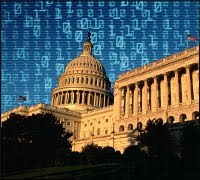
Today, the Senate Homeland Security and Government Affairs Committee unveils its legislation, which would create a Senate-confirmable cyber director in the executive office of the president and imbue him or her with significant emergency powers. The Protecting Cyberspace as a National Asset Act of 2010 (PC-NNA ... PC Nana?) is "designed to bring together the disjointed efforts of multiple federal agencies and departments to prevent cyber theft, intrusions, and attacks across the federal government and the private sector," its chief author, Sen. Joe Lieberman, will say in prepared remarks today. "The bill would establish a clear organizational structure to lead federal efforts in safeguarding cyber networks. And it would build a public/private partnership to increase the preparedness and resiliency of those private critical infrastructure cyber networks upon which our way of life depends."
The bill would create another Senate-confirmable position, the head of a new National Cybersecurity and Communications Center inside the Department of Homeland Security; the new NCCC would be responsible for threat prevention and mitigation. It would develop risk-based standards for infrastructure with industry and oversee their implementation. Private entities whose power plants or grids or systems are considered vulnerable and critical could choose among a menu of standards.
According to a summary of the legislation, the Act would also create a "responsible" framework for giving the executive branch significant emergency power in the event of a major intrusion or threat.
The President must notify Congress in advance about the threat and the emergency measures that will be taken to mitigate it. Any emergency measures imposed must be the least disruptive necessary to respond to the threat. These emergency measures will expire after 30 days unless the President orders an extension. The bill does not authorize any new surveillance authorities, or permit the government to "take over" private networks.
Industry will read this part of the bill very carefully, as will civil libertarians. The White House believes it already has a lot of these powers, although it welcomes Congress's attempt to codify them, but my sense is that the National Security Staff does not want to create any new cyber infrastructure within the already over-burdened executive office of the president, and isn't keen on having the top two cyber positions be Senate confirmable.
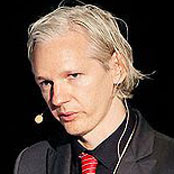
from philip shenon: Anxious that Wikileaks may be on the verge of publishing a batch of secret State Department cables, investigators are desperately searching for founder Julian Assange. Philip Shenon reports. Plus, Daniel Ellsberg tells The Daily Beast: "Assange is in Some Danger." (This story has been updated to reflect new developments on Assange's whereabouts, including the cancelation of a scheduled appearance in Las Vegas.)
The officials acknowledge that even if they found the website founder, Julian Assange, it is not clear what they could do to block publication of the cables on Wikileaks, which is nominally based on a server in Sweden and bills itself as a champion of whistleblowers.
“We’d like to know where he is; we’d like his cooperation in this,” one U.S. official said of Assange.
American officials said Pentagon investigators are convinced that Assange is in possession of at least some classified State Department cables leaked by a 22-year-old Army intelligence specialist, Bradley Manning of Potomac, Maryland, who is now in custody in Kuwait.
And given the contents of the cables, the feds have good reason to be concerned.
from afp: In the quest for better targeted advertising, marketers are using high-tech tools that can pinpoint a person's location, demographics and habits, raising the hackles of privacy activists.
Online or in the shopping mall, these efforts are becoming more prevalent. Google, Yahoo and its advertising partners can track a user's browsing habits in an effort to deliver more relevant marketing messages.
Offline, new digital signs with hidden cameras can use facial recognition software to tailor messages similar to the scenario in the science fiction film "Minority Report." Some analysts say the new technology is positive, enabling firms to get the most for their advertising dollars.
"We're marketers. We present consumers with information that they can use to make informed buying decisions related to our brands," says Rob Graham, vice president at the consulting firm Laredo Group.
"Contrary to what many marketers claim, most adult Americans (66 percent) do not want marketers to tailor advertisements to their interests," the study concluded. "Moreover, when Americans are informed of three common ways that marketers gather data about people in order to tailor ads, even higher percentages... say they would not want such advertising."
Chris Hoofnagle, director of the Berkeley Center for Law and Technology's information privacy programs, said many Web users are aware their habits are tracked by firms such as Google or Amazon, but are unsettled by third-party advertisers and marketers tracking across websites without any permission.
"Individuals don't want to be tracked," he said. "It might not cause you harm, it might just be creepy." The practices underscore concerns over online privacy at a time when social network giant Facebook is embroiled in its own controversy over sharing data with third-party websites.
New technology is also testing the limits of acceptable practices and privacy offline. In some shopping malls, a new generation of digital signs not only can change messages frequently but can measure customer traffic and determine who is walking by through facial recognition software.
To some, it raises the specter of the scene in "Minority Report" where Tom Cruise's character walks through a futuristic mall.
"John Anderton. You could use a Guinness right about now," a digital sign announces in the film.
"We're not quite there yet but we are at a point where we can adjust the ads according to who is in front of that screen," said Keith Kelsen, chairman and chief executive of Media Tile, a digital signage firm.
Kelsen said the signage industry has a set of guidelines to protect privacy, and dismissed most of the fears as overblown.
"There is really no reason for concern because we're not tracking individuals, we're tracking information that is collected on whether they are male or female, or quantities of people, how long do they look at the screen," he said.
But some privacy activists say the industry has not done enough to protect against abuses.
"The vast majority of people walking in stores, near elevators and in other public and private spaces have no idea that the innocent-looking flat screen TVs playing videos may be capturing their images and then dissecting and analyzing them for marketing purposes," said a January report by the World Privacy Forum.
Pam Dixon, executive director of the privacy group, said the digital signage industry "has all sorts of issues touching privacy, including children's privacy."
The campaign was ended after a few days amid criticism.
Some makers of the technology, including firms like South Korea's Samsung and Japan's NEC, may be able to determine a viewer's race or nationality and can personalize Google and Yahoo! ads.
Companies are also using GPS technology in mobile phones to tailor ads to a user's location, such a specials for lattes as someone walks by a coffee shop.
"The emerging system for mobile advertising is clearly an extension of the current interactive targeting apparatus that has raised so many concerns over privacy and consumer protection," the group said in a petition to US regulators.
 from paul joseph watson & alex jones: The move to shut down and regulate the Internet under a new government-controlled system has accelerated into high gear with the announcement that the government’s cybersecurity strategy revolves around issuing Internet users with ID “tokens” without which they will not be able to visit websites, the latest salvo against web freedom which, in combination with Senator Joe Lieberman’s ‘kill switch’ bill, will serve to eviscerate the free Internet as we know it.