ibm: the solutions company, the final solutions company... 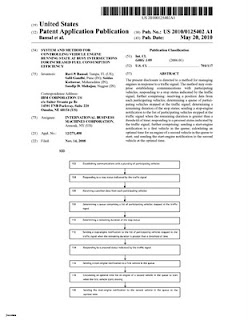 from jalopnik
:
A patent application filed by IBM engineers reveals the company’s developing technology that will allow governments to shut down the engines of private automobiles via traffic signals. It’s like Skynet… only much worse. Engineers from IBM, suddenly free from the burden of making computers, are hoping to ruin the driving experience by handing over the ability to stop and start car engines over to traffic lights, railroad crossing gates and other transportation signals... The goal of the system is to lower fuel usage and optimize the movement of vehicles through intersections by controlling engine operations remotely via traffic signals. A railroad crossing could sense the vehicles in the general vicinity were going to be stuck for a while and would then cut the power to save gas. It's similar to the start/stop systems on a few modern cars but taken to perverse extremes.
from danger room:
Everybody is dumping on Facebook right now – & CEO Mark Zuckerberg’s non-apology apologies for giving away his customers’ personal information aren’t exactly helping matters. But in the military community, there’s an interesting twist on the Facebook-as-privacy-sieve debate. Turns out the names of soldiers dying in Afghanistan are sometimes appearing on Facebook before they’re officially released.
This is not a small deal in military circles. U.S. bases in Iraq and Afghanistan go into what’s called “River City” - with access to the outside Internet shut down - when one of their troops is killed in action. The idea is to give time to notify next-of-kin before word of the death leaks out.
Last Wednesday, however, King’s College of London PhD student Daniel Bennett was able to penetrate that veil of silence. With a few clicks of the social media search engine Kurrently, Bennett found Facebook chatter about the death of 20 year-old Pfc. Billy G. Anderson (pictured) in Afghanistan’s Badghis province. The Pentagon didn’t announce that Anderson had been killed until two days later, on Friday the 21st.
From what I can tell, this Facebook leak appears to have come from Anderson’s parents, indirectly. On Tuesday the 19th at 9:09am, Robin McAllister Vance wrote on her Facebook wall: “Please pray for the family of Billy Anderson. This is the son in law of Gina Lewis, who works with me in Accounting. They learned yesterday that Billy was killed in Afghanistan. Billy is survived by a young wife and baby girl.” But I’m guessing news of other battlefield deaths has spread on Facebook even faster, before families heard the news.
It’s exactly the kind of personal information that the armed forces have begged its troops for years not to disclose online. It’s exactly the kind of material that caused some branches of the military to block access to Web 2.0 sites from their networks for a while.
 from kurt nimmo
:
NSA Director Lt. Gen. Keith Alexander told the Senate Armed Services Committee in April that he would work to protect the privacy rights of Americans online. It was an interesting comment from a man who heads up an organization responsible for a massive program of illegal dragnet surveillance of domestic communications and communications records of millions of ordinary Americans since at least 2001.
“NSA is the only place in the U.S. government that has the capabilities we need for defense of the private networks,” James A. Lewis, a senior fellow and cybersecurity expert at the Center for Strategic and International Studies, told the CIA’s favorite newspaper last year. “We need to find a way to use those capabilities without putting civil liberties at risk.” CSIS is an insider think tank dominated by the likes of Zbigniew Brzezinski, Brent Scowcroft, Henry Kissinger and other freedom lovers.
Threats against computer networks in the United States are grossly exaggerated. Dire reports issued by the Defense Science Board and the Center for Strategic and International Studies “are usually richer in vivid metaphor — with fears of ‘digital Pearl Harbors’ and ‘cyber-Katrinas’ — than in factual foundation,” writes Evgeny Morozov, a Belarus-born researcher and blogger who writes on the political effects of the internet.
Morozov notes that much of the data on the supposed cyber threat “are gathered by ultra-secretive government agencies — which need to justify their own existence — and cyber-security companies — which derive commercial benefits from popular anxiety.”
On Friday Alexander was appointed to head up the newly activated Cyber Command, a subordinate unified command under United States Strategic Command “designed to conduct virtual combat across the world’s computer networks,” according to The Guardian. The ceremony held at Fort Meade, Maryland, was “low-key” in order to not draw media attention.
Early last week the Air Force assigned approximately 30,000 “digital troops” to “the front lines of cyber warfare,” a number that represents a third of the troops in Afghanistan. “The transformation is part of the service’s larger emphasis on cyberspace operations and merging most computer system operations and network warfare functions under Space Command’s 24th Air Force, based at Lackland Air Force Base, Texas,” reported the Air Force Times on May 19.flashback: military response to cyber attack 'possible'
as cryptogon notes: guess which goons will have the largest role in recovery efforts after any 'virtual flag terrorism'... from danger room
:
Coincidences sure are funny things. Booz Allen Hamilton - the defense contractor that's become synonymous with the idea that the U.S. is getting its ass kicked in an ongoing cyberwar - has racked up more than $400 million worth of deals in the past six weeks to help the Defense Department fight that digital conflict. Strange how that worked out, huh?
Everyone in the Pentagon from Defense Secretary Bob Gates on down says that the military needs to cut its reliance on outside contractors. But few firms are as well-connected as Booz Allen, the one-time management consultancy that today pulls in more than $2.7 billion in government work. And few firms sound the alarm as loudly about a crisis that they’re in the business of fixing. Back in February, for instance, former National Security Agency director and Booz Allen Hamilton executive vice president Mike McConnell declared that “the United States is fighting a cyber-war today, and we are losing.” The White House’s information security czar is one of many experts who calls such rhetoric overheated, at best. That hasn’t stopped Booz Allen from pocketing hundreds of millions of dollars from Washington to wage those battles.
Booz Allen’s latest awards were announced last Thursday — nine contracts with the Air Force, totaling over $150 million. One deal gives the firm $24 million to “provide combat-ready forces to conduct secure cyber operations in and through the electromagnetic spectrum.” A $19.8 million contract asks Booz Allen to “define information assurance scientific and technical analysis to be applied to future military satellite communication systems development.” Earlier in the month, the company got $14 million to “provide threat monitoring, detection, characterization, and actionable information for the computer network operations in order to help advance Department of Defense Global Information Grid initiative and nationally oriented cyber security priorities.”
That sounds not dissimilar to what McConnell asked for in February.
 from v3.co.uk
:
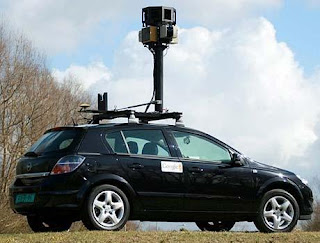
Google has admitted that it has been recording data transmissions on Wi-Fi networks using its Street View cars.
Alan Eustace, senior vice president of engineering and research at Google, explained in a blog post that, while Google routinely collects wireless information such as network names, it has also been collecting payload data from open Wi-Fi points for the past four years.
"So how did this happen? Quite simply, it was a mistake. In 2006 an engineer working on an experimental Wi-Fi project wrote a piece of code that sampled all categories of publicly broadcast Wi-Fi data," he said. "A year later, when our mobile team started a project to collect basic Wi-Fi network data like SSID information and MAC addresses using Street View cars, they included that code in their software, although the project leaders did not want, and had no intention of using, payload data."
Eustace said that Google has shut down the Street View fleet until the company is sure that the software has been removed, and will bring in an independent third party to verify that the code has been expunged and fully deleted.
However, privacy watchdogs and consumer groups have pounced on the news as yet another example of Google's demonstrating a lack of concern for privacy.
"Google's computer engineers run amok, push the envelope and gather whatever data they can until their fingers are caught in the cookie jar," said John Simpson, consumer advocate with the Consumer Watchdog group. "Then a Google executive apologises, mouthing bafflegab about how privacy matters to the company."
Simpson added that Google's plan to have an unnamed third party study what went wrong, and to check that the improperly gathered private data has been eliminated, is inadequate. "That's like getting to pick the referees in a championship football game," he said.related/updates:
google data collection eyed by congress, class action lawsuit* google to offer encrypted search next week*
prepping us for the coming of 'virtual flag terrorism'  from defence talk
:
The Pentagon would consider a military response in the case of a cyber attack against the United States, a US defense official said on Wednesday. Asked about the possibility of using military force after a cyber assault, James Miller, undersecretary of defense for policy, said: "Yes, we need to think about the potential for responses that are not limited to the cyber domain."
But he said it remained unclear what constituted an act of war in cyberspace. "Those are legal questions that we are attempting to address," Miller said at a conference in Washington, adding that "there are certainly a lot of grey areas in this field."He said hostile acts in cyberspace covered a wide range, from digital espionage to introducing false data into a network, that did not necessarily represent full-blown war.
But he said the threat to US networks from terrorists, criminals and others was real and growing. "Over the past decade, we've seen the frequency and the sophistication of intrusions into our networks increase," he said. "Our systems are probed thousands of times a day."
The Defense Department has about 90,000 employees and troops using computer networks, with about seven million computer devices, he said.
The US military recently created a new cyber command that will be led by Lieutenant General Keith Alexander, head of the secretive National Security Agency. Alexander was confirmed in his post by the US Senate last week.
In his written testimony to Congress, Alexander said that the new cyber command would be prepared to wage offensive operations as well, despite the risk of sustaining damage to US networks. He told lawmakers that he expected digital operations to take place as part of a wider military campaign, but that special legal authority would be required to respond to a cyber attack staged from a neutral country.
remember kids:
in-q-tel, the investment arm of the cia, helped fund facebook...  from read write web
:
Facebook doesn't make it easy to delete your account, but a growing number of people appear to be turning to Google to find out how to do just that. Google Suggest, the drop-down box that offers suggested search query completions based on absolute and recent upticks of popularity, now guesses that if you start typing "How do I..." that you'd like to know how to quit Facebook. Note that deactivating your account, something that Facebook responds to in a pretty shocking way as well, is not the same as deleting it.
Search maven Danny Sullivan noted the suggestion on Twitter this morning, but a growing number of industry watchers are talking about people deleting their Facebook accounts. Some, including at least two members of our own staff, have already done so. Google Suggest suggestions are often humorous, but the screenshot below is pretty serious stuff.
So how do you delete your Facebook account? Even that is pretty remarkable! According to the #1 search result for the query, which is an unofficial Facebook group page written by someone else, you have to visit facebook.com/help/contact.php?show_form=delete_account. On that page you'll find a delete button. According to said unofficial group, you'll still be able to bring your account back if you log-in within the next two weeks! You won't show up in search results though, neither in Facebook nor in Google. It's as if they can't see you anymore."It was terribly dangerous to let your thoughts wander when you were in any public place or within range of a telescreen. The smallest thing could give you away. A nervous tic, an unconscious look of anxiety, a habit of muttering to yourself-anything that carried with it the suggestion of abnormality, of having something to hide. In any case, to wear an improper expression on your face...; was itself a punishable offense. There was even a word for it in Newspeak: facecrime..." -- George Orwell, 1984
For the record, I have not deleted my Facebook account as I enjoy the service too much and feel the need to keep an eye on its innovations and transgressions. You can subscribe to ReadWriteWeb's good news and bad news about Facebook and the rest of the web here on Facebook.related: facebook's gone rogue; it's time for an open alternative
 from the register
:
Websites operated by the US Treasury Department are redirecting visitors to websites that attempt to install malware on their PCs, a security researcher warned on Monday. The infection buries an invisible iframe in bep.treas.gov, moneyfactory.gov, and bep.gov that invokes malicious scripts from grepad.com, Roger Thompson, chief research officer of AVG Technologies, told The Register. The code was discovered late Sunday night and was active at time of writing, about 12 hours later.
To cover their tracks, the miscreants behind the compromise tailored it so it attacks only IP addresses that haven't already visited the Treasury websites. That makes it harder for white hat-hackers and law enforcement agents to track the exploit. Indeed, Thompson initially reported that the problem had been fixed until he discovered the sites were merely skipping over laboratory PCs that had already encountered the attack.
The attack is most likely related to mass infections that two weeks ago hit hundreds of sites hosted by Network Solutions and GoDaddy, said Dean De Beer, founder and CTO of security consultancy zero(day)solutions. He made that assessment based on the observation that the compromised Treasury websites are hosted at Network Solutions and the owner of grepad.com is also the owner of record for most of the websites used in the earlier attacks. "There's a very high probability that it's the same person," De Beer said. "The only things that are changing are the domains."
Earlier, Thompson speculated the attack might be the result of someone exploiting a SQL injection vulnerability on the Treasury websites. After investigating that possibility, De Beer said it was unlikely because the hacked Treasury sites contained static HTML pages that aren't susceptible to such exploits. Media representatives at the Treasury Department didn't return a phone call seeking comment.
 from steve watson
:
Police signs have begun springing up in internet cafes in London warning users that they could be reported to the police and face criminal charges if they access “extremist”, “offensive” or “inappropriate” material. The signs, which state that the owners of the premises are actively working with the Metropolitan police, have drawn criticism due to their vagueness and questionable legality. “Downloading or accessing certain material could constitute a criminal offence” states the bright pink sign. Comments concerning the signs on both flickr and popular blog site Boing Boing encapsulate the threat such policies pose... We have previously reported on filtering and blocking of all kinds of political websites including Prisonplanet.com in public domains in both the UK and the US. This type of catch all censorship creep is part of an ongoing agenda to use legitimate concerns such child pornography to regulate and control the internet as a whole.
 from threat level
:
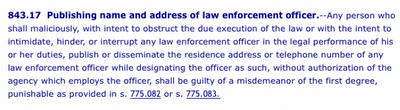
A federal judge has struck down a Florida law prohibiting the publication of a police officer’s name, phone number or address, calling the statute an unconstitutional restraint on speech. The decision leaves Arizona, Colorado and Washington state with similar laws on the books. Florida authorities said Wednesday they were mulling whether to appeal. Robert Brayshaw, a 35-year-old apartment manager, brought the challenge to Florida’s law after he was briefly jail in 2008 for posting personally identifying information of a Tallahassee police officer on RateMyCop.com — a 2-year-old website that lets users rate and comment on the uniformed police officers in their community. RateMyCop uses public records requests to gather the names and, in some cases, badge numbers of thousands of uniformed cops at police departments around the country, and allows users to post comments about police they’ve interacted with. The site’s launch in 2008 drew cries of outrage from police, who complained that they’d be put at risk if their names were on the internet.
 from fcw
:
Cyberattacks aren’t confined by governmental or national boundaries, and neither should cybersecurity programs, Sen. Jay Rockefeller (D-W. Va.), said recently in calling on government and industry to work together to meet the rapidly rising tide of attacks on U.S. information systems.
“National borders and traditional notions of security do not always apply to 21st--century threats, especially in the cybersecurity arena,” he said April 29 at the Business Software Alliance’s Cybersecurity Forum 2010 in Washington. “The idea that government alone can protect our citizens’ security within clear national borders is outdated. Therefore, to secure our country from cyberattacks we must have shared responsibility — public sector and private sector.”
Rockefeller’s bill (S. 773), co-sponsored with Sen. Olympia Snowe (R-Maine), was approved by the Senate Commerce, Science and Transportation Committee March 24. It builds on the idea that cybersecurity is a shared responsibility between the public and private sectors, Rockefeller said. “That’s what this whole bill is about,” he said. Rockefeller chairs the committee.flashback: cyberbill to give president new emergency powers
 from baltimore business journal: There are still more questions than answers, but information trickling out from the Pentagon is giving a clearer sense for what the military’s cyber security headquarters at Fort George G. Meade will look like.