As we've reported, Google says it's planning to roll out and test "ultra-high speed broadband networks" in various trial areas around the United States. And they sound pretty darned ultra: one gigabit per second, fiber-to-the-home connections "at a competitive price" to cities and regions of 50,000 to ten times that many people.
Portland says if you build it, we will download. But beyond that, why should Google choose that rainy northwestern city where people prefer to rust rather than tan? Here are some answers the RFP gives.
First, hardcore telecommuters, Portlanders like to work at home, or "over Wi-Fi in coffee shops, or in co-working spaces," the RFP notes. In fact, "nine Portlanders telecommute for every one who commutes by light rail." Plus it's a small business city—within Multnomah County, three out of four businesses have ten employees or less.
Next, Portlanders are huge long-term planners of the green variety. This was the first city to embrace a plan for global warming, the document adds. Its emissions levels have dropped 14 percent while national emissions continue to go up. The town already serves as a test site for sensor nets, telemedicine, and advanced geolocation services.
And Portland "was the first government in the nation to endorse 'open access' requirement to then-emerging broadband Internet platforms," doing so back in December of 1998. Google's project, it should be noted, will be open access—letting users choose from a variety of ISPs.
This all sounds pretty competitive to us (we, of course, aren't making the decision). Applicants had until March 26 to make their move; as cities now reveal their applications, everyone else can see what they are up against. Google may take until the end of this year to make its decision.
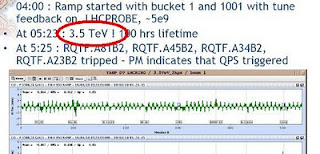
lhc particle-punisher in record 7tev hypercollisions from theregister.co.uk: It's official: as this is written, the most powerful particle collisions ever achieved by the human race are taking place inside the great subterranean detector caverns of the Large Hadron Collider (LHC). An initial hiccup this morning saw an overly-jumpy automatic protection system quench a magnet and dump one of the beams, but boffins at the colossal 27-km machine's controls fought back to re-establish a ring of lightspeed 3.5 tera-electron-volt (TeV) protons in the affected magno-doughnut in time for lunch.
cern hit problems on start of high energy collisions from telegraph: Dubbed the world's largest scientific experiment, the giant atom smasher holds the promise of revealing details about theoretical particles and microforces, scientists say. But initial attempts on Tuesday were unsuccessful because problems developed with the beams, said scientists working on the massive machine. That meant that the protons had to be "dumped" from the collider and new beams had to be injected. "It's a very complicated machine and we have ups and downs," said Michael Barnett of Lawrence Berkeley National Laboratory. "Right now we have a down." ... The European Organization for Nuclear Research, or CERN, is trying to use the powerful superconducting magnets to force the two beams to cross, creating collisions and showers of particles. They could have been successful immediately, but such huge machines can be so tricky to run that it could take days.
aging spies unable to use the internet from telegraph: Having battled Islamic extremists, Irish Republican terrorists and Russian spies, some of the veteran intelligence officers of MI5 are encountering a foe they cannot master: information technology ... The Security Service is launching an unprecedented round of redundancies to improve the overall level of computer skills among its staff. Despite an expanding budget, MI5 is laying off employees in order to hire new intelligence officers and support staff with better command of information technology and other “deployable” skills. The redundancy programme has set tongues wagging in Whitehall, with civil servants in other departments joking about a “James Bond generation” of elderly spies being put out to pasture because they can’t use the internet and don't understand the world of Twitter or Facebook. The plan was disclosed by Jonathan Evans, the director-general of MI5.
Wikileaks claims on Twitter regarding the upcoming screening to be at work. Employees would be monitored by the U.S. and Icelandic authorities. These are photos and videos taken of the employees, an employee is 22 hours would be arrested and tried to get the video.
The Web site Wikileaks is very controversial, because the documents of governments and companies with scandals reveals. Last year the site was ordered by a U.S. court concluded ten days, because the Swiss bank Julius Baer about his money laundering in the Cayman Islands did not read back online.
surprise: the site was set up & run by cia/saudi intel! from washington post: By early 2008, top U.S. military officials had become convinced that extremists planning attacks on American forces in Iraq were making use of a Web site set up by the Saudi government and the CIA to uncover terrorist plots in the kingdom.
“We knew we were going to be forced to shut this thing down,” recalled one former civilian official, describing tense internal discussions in which military commanders argued that the site was putting Americans at risk. “CIA resented that,” the former official said.
Elite U.S. military computer specialists, over the objections of the CIA, mounted a cyberattack that dismantled the online forum. Although some Saudi officials had been informed in advance about the Pentagon’s plan, several key princes were “absolutely furious” at the loss of an intelligence-gathering tool, according to another former U.S. official...
The Saudi-CIA Web site was set up several years ago as a “honey pot,” an online forum covertly monitored by intelligence agencies to identify attackers and gain information, according to three of the former officials. The site was a boon to Saudi intelligence operatives, who were able to round up some extremists before they could strike, the former officials said.
The dealership used a system called Webtech Plus as an alternative to repossessing vehicles that haven’t been paid for. Operated by Cleveland-based Pay Technologies, the system lets car dealers install a small black box under vehicle dashboards that responds to commands issued through a central website, and relayed over a wireless pager network. The dealer can disable a car’s ignition system, or trigger the horn to begin honking, as a reminder that a payment is due. The system will not stop a running vehicle...
First rolled out about 10 years ago, remote immobilization systems are a controversial answer to delinquent car payments, with critics voicing concerns that debtors could suffer needless humiliation, or find themselves stranded during an emergency. Proponents say the systems let financers extend credit to consumers who might otherwise be ineligible for an auto loan.
from dodbuzz: Black-Cyber-Operations have become all too common, launching highly sophisticated cyber actions against their targets that go undetected for months or years. A black operation is generally accepted worldwide by militaries and intelligence agencies to represent specific types of covert operations typically involving activities that are either secret or of questionable legitimacy and often violate international law and demand deniability.
Russia began developing black-cyber-ops teams as far back as the early 1990s. But Russia is not the only military with these capabilities. A Chinese black-ops team is credited with the design and execution of the “Titan Rain” initiative that long went unchecked and undetected deep inside the U.S. Department of Defense networks. This cyber event is said to be second only to the cyber attack that hit the Pentagon in 2008 and impacted both theaters of operation (Afghanistan and Iraq).
These highly specialized teams are rarely talked about in the open media, but sometimes come up in quiet, off-line conversations at conferences. Recently, at a cyber warfare event, the lunch break conversation turned to cyber weapons. “If I were to start a business today, I would start a black-cyber-ops and cyber weapons development organization,” I told those sitting nearby. Somebody (from a three letter organization) leaned over, tapped me on the shoulder and said, “I’ll be your first customer.”
As the conversation went on, another said, “We need the equivalent of a Cyber Blackwater” (or Xe). While there are black-cyber-ops organizations around the world and cyber arms developers and dealers, this appears to be an underserved market niche. Given the attention cyber warfare is now receiving, you can bet there will be more such organizations going active in the next few years.
FACT: Black-Cyber-Ops are often used for political, military, intelligence and business reasons.
FACT: The only difference between a cyber weapon and a security or capacity testing tool is the intent of the individual using it.
FACT: There is a reference to at least one Black-Cyber-Ops Conference that was said to involve the Israeli Military and the Mossad.
from bbc: The US is in the process of creating a unified cyber command, to fight the wars of the future. The Pentagon has no doubt that the next conventional war will include a cyber element.
Looking out of a window in London's Canary Wharf, Daniel Kuehl gestures randomly towards a high-rise. "Let's just assume that somewhere in that building there are a bunch of cyber systems, networks, routers, that are militarily important to take out," he said. "Which would you think would be the better way of doing it in terms of this neighbourhood? To make it stop working through a bunch of key strokes or to put a laser-guided, 1,000-lb weapon through the third floor and blow it to shreds? We're really good at that second operation - but there might be some advantages to doing it the first way."
The Pentagon is creating its first fully fledged cyber command - USCybercom - to improve its ability to wage war with key strokes...
Not everyone is convinced of USCybercom's military value. One US official at the London conference said that if cyber warfare was a WMD it was only a weapon of "mass disruption, not destruction".
But the US Senate is expected to confirm Lt Gen Keith Alexander, who also heads the US National Security Agency (NSA), as head of USCybercom in the near future.
If this happens, he will rise to the rank of a four-star general, and his new command will get its badge and take its place in the military.
"Believe me, creating an organisation led by an officer of that rank is not easy," says Daniel Kuehl. "It's not simple and it's not done unless there are perceived to be very, very pressing reasons for doing so. We are deadly serious about this."
webster tarpley: US readies cyberwar, virtual flag terrorism from russia today: Cyber wars and cyber security are no longer fictional plots from science fiction movies. They are very real and very serious concerns for the American people, being tracked by politicians and the government in Washington. Webster Tarpley gives his opinion on the seriousness of the cyber threat.
from 9news: Federal prosecutors have charged a former Transportation Security Administration employee with attempting to sabotage terror watch list computers. Douglas Duchak, 46, of Colorado Springs, faces two charges of attempting to damage protected TSA computers.
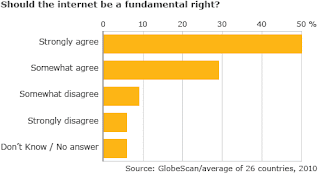
from bbc: Almost four in five people around the world believe that access to the internet is a fundamental right, a poll for the BBC World Service suggests.
The survey - of more than 27,000 adults across 26 countries - found strong support for net access on both sides of the digital divide.
Countries such as Finland and Estonia have already ruled that access is a human right for their citizens.
International bodies such as the UN are also pushing for universal net access.
"The right to communicate cannot be ignored," Dr Hamadoun Toure, secretary-general of the International Telecommunication Union (ITU), told BBC News. "The internet is the most powerful potential source of enlightenment ever created." He said that governments must "regard the internet as basic infrastructure - just like roads, waste and water ... We have entered the knowledge society and everyone must have access to participate."
Web users questioned in South Korea and Nigeria felt strongly that governments should never be involved in regulation of the internet. However, a majority of those in China and the many European countries disagreed.
In the UK, for example, 55% believed that there was a case for some government regulation of the internet.
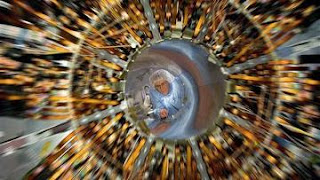
from ria novosti: A detailed check of the Large Hadron Collider (LHC) running at a low energy has showed that it is "performing well," the European Organization for Nuclear Research (CERN) said on its website Thursday.
Work to repair and upgrade the collider after the breakdown cost almost $40 million and took more than a year. A system to protect it from such accidents, named the Quench Protection System, was installed, and the first beams were injected into the LHC on November 20 last year.
In its first six weeks of observations, it has discovered 16 previously unknown asteroids with orbits close to Earth's. Of these, 55% reflect less than one-tenth of the sunlight that falls on them, which makes them difficult to spot with visible-light telescopes. One of these objects is as dark as fresh asphalt, reflecting less than 5% of the light it receives.
Many of these dark asteroids have orbits that are steeply tilted relative to the plane in which all the planets and most asteroids orbit. This means telescopes surveying for asteroids may be missing many other objects with tilted orbits, because they spend most of their time looking in this plane.
Fortunately, the new objects are bright in infrared radiation, because they absorb a lot of sunlight and heat up. This makes them relatively easy for WISE to spot.
from arstechnica: The Internet has surpassed newspapers as a primary way for Americans to get news, according to the Pew Internet and American Life Project. That makes the Internet the third most popular news platform overall, with many connected users taking advantage of nontraditional consumption methods such as social media postings, personalized news feeds, and getting their news on-the-go. National and local TV stations still dominate the news cycle for most Americans, but the Internet now stands third in the list, ahead of national and local newspapers. Additionally, the majority of news consumers say they use two to five websites per day to get their fix - a number we think sounds about right - but a surprisingly high number (21%) rely on that one favorite site to get everything they need.
 from ars technica: The City of Portland, Oregon says it's ready to be one of Google's test run fiber-to-the-home projects, and how: "No city in the USA is as ready as Portland to launch a citywide or scaled test bed for ultra high speed open platform broadband," its response to Google's Request for Proposals proudly declares. "Portland has the history, broad community support, willing businesses, committed local government, and cost-effective, year-round construction metrics."