Showing posts with label europa. Show all posts
Showing posts with label europa. Show all posts
Tuesday, March 5, 2013
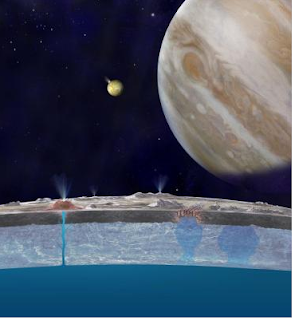
Europa Ocean Favorable To Life

Thursday, October 25, 2012
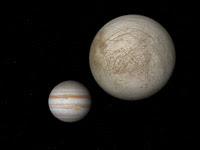
Ocean Of Europa Deepest In Solar System?
Friday, October 28, 2011
jupiter moon io: hotspot in outer solar system
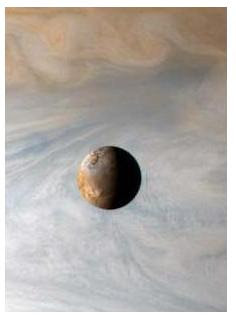 Scientists are excited about possibility of life in outer reaches of solar system. Three moons attract much interest: Europa, Titan and Enceladus previously covered here. Europa with its global-wide ocean hidden beneath a frozen shell of ice. Titan with an appearance similar to Earth once below the clouds obscuring it. Enceladus, a small Saturn moon, attractive with visible geysers near its south pole. Some scientists argue that Jupiter's moon Io (pictured) deserves attention as possibly harboring extreme life forms! Io is the fourth largest moon in the solar system and closest to Jupiter of the four large Galilean moons. An article at The Daily Galaxy, "Jupiter's Io - Volcanic Hotpsot of the Solar System," reveals a moon with an incredible amount of volcanic activity a "...global magma ocean about 30 to 50 kilometers (20 to 30 miles) beneath Io's crust [that] helps explain the moon's activity... The energy for the volcanic activity comes from the squeezing and stretching of the moon by Jupiter's gravity as Io orbits the largest planet in the solar system..." Io's high volcanic activity, the possibility of protection provided by lava tubes below its surface, give scientists hope for life there. Life in the fiery depths of Io would likely be different and an extreme form. The search will continue for life--and extreme life! Io pictured with Jupiter behind it - just spectacular!
Wednesday, October 19, 2011
life in the outer solar system
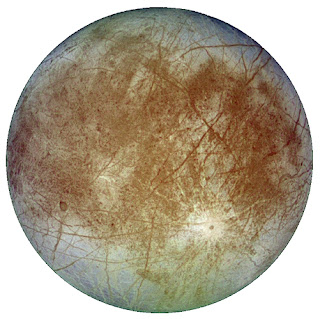 Europa seems high on a short list of worlds to explore. The Jovian moon has a global-wide ocean underneath a surface of solid ice, the prospect of finding life seems promising. Mark Elowitz's Europa Exobiology page provides excellent pictures and even suggests an explanation for the reddish spots, which may be warmer ice rising near the surface? There are practice sessions already underway for a possible Europa mission as revealed in Space.com article, "Antarctic Diving Robot Practices for Europa Mission". Europa, slightly smaller than the Moon, is not the only moon in the outer solar system to draw attention.
In a recent Universe Today article, "A Tale of Three Moons: Is There Life in the Outer Solar System?", Paul Scott Anderson writes about Enceladus, a small icy moon of Saturn, previously thought unlikely to harbor life, "but then Cassini saw the geysers, plumes of material erupting from the south polar region through large, warmer cracks nicknamed “tiger stripes.” Cassini has now flown directly through the geysers, analyzing their composition, which is mostly water vapor, ice particles, salts and organics. The latest analysis based on the Cassini data indicates that they almost certainly originate from a sea or ocean of liquid water below the surface. Warm, salty water loaded with organics; could Enceladus be another possible niche for extraterrestrial life? As with Europa, only further missions will be able to answer these questions, but the possibilities are exciting."
Titan, Saturn's largest moon, long perceived as too cold to sustain life is receiving renewed interest. Once, the Cassini lander probe Huygens dropped below cloud cover, Anderson writes, "Titan is like an eerily alien version of Earth, with rain, rivers, lakes and seas, but being far too cold for liquid water (not much heat here), its “water cycle” is composed of liquid methane/ethane. Appearance-wise, the surface and geology look amazingly Earth-like..." Scientists have considered whether methane-based life exists on Titan? "Future proposed missions for Titan include a floating probe to land in one of the lakes and a balloon to soar over the landscape, pursuing such mysteries as never before. How cool is that?", writes Anderson. It is pretty cool!
Tuesday, March 8, 2011
lake vostok mystery
 Mystery builds as Russians quit drilling for season. The drill lies less than 50 feet from subglacial Lake Vostok environment. Russians leave a two mile borehole filled with kerosene to prevent freezing, until drilling resumes in December. Mystery surrounds the lake even thicker than the two miles of ice covering it. There is a reluctance to penetrate an environment separated from the rest of the world for thousands of years. The pristine lake could be contaminated in the process, but release of pressurized gases is also a concern.
Vostok station was established in 1957 by the Russians, who suspected the presence of water. A.P.Kapitsa attempted to verify a freshwater lake by seismic measurements in the fifties and sixties, but data failed to confirm it. Russian scientists were convinced though physical pressure exerted by the ice sheets, could reach melting temperatures.
In 1974, British scientists did a radar survey by flying over Antarctica and uncovered the terrain below ice of predominantly mountains, and on Christmas Day, what appeared to be a lake. A satellite study by space-based radar in 1991 confirmed the presence of one of the largest lakes in the world. A documentary, "The Lost World of Lake Vostok," provides an excellent summary of efforts made in the discovery.
Lake Vostok lies not only two miles down in complete darkness, but apparently a very old and deep lake. Vostok is about the size of Lake Ontario but with twice the volume and almost half as deep as Lake Baikal--the deepest lake in the world. NASA became interested because of similarities to Europa and viewed the lake as a testing ground.
Mystery helped propagate rumors a decade ago, when a NASA press conference was interrupted after allusions to "national security" concerns and intervention by the NSA.
The Art Bell show contributed to controversy with statement on air scientists were suffering ailments after returning from the South Pole. A McMurdo Station physician made a comment at the time to his replacement, "fill your pockets with salt," a hint to bring
iodine tablets because of radiation. It didn't end there.
Two million missing Nazis and base 211 have been tied to the lake. A 2009 Science Daily article can be worked into the conspiracy web, reporting a dynamic network of lakes below Antarctica--what better place for Nazi U-boats? The conspiracy-fest continues with possibility a large crystal, which powered legendary Atlantis, is the source of the magnetic anomaly detected at one end of Lake Vostok.
Is all the hype comic book fantasy or disinfo agents at work to obfuscate reality? Worse, has a virus we haven't encountered been released? Or, is the South Pole going to suffer a similar fate as the Gulf of Mexico? We won't have long to wait, December is the last month before apocalyptic 2012!
Subscribe to:
Posts (Atom)