Showing posts with label space exploration. Show all posts
Showing posts with label space exploration. Show all posts
Thursday, October 4, 2012
55 Years of Space Exploration, 1957 - 2012
A fast history of space exploration provided by You Tube video "55 Years of Space Exploration, 1957 - 2012," gets packed into little over five minutes! Don't you wish all your history classes were as quick? Thanks goes to Universe Today and Northwestern University Space Technology and Rocketry Society.

Wednesday, October 19, 2011
life in the outer solar system
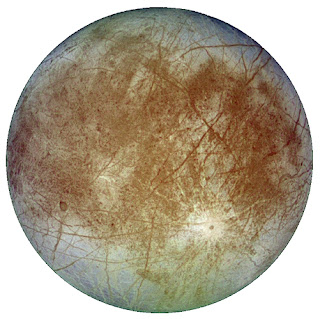 Europa seems high on a short list of worlds to explore. The Jovian moon has a global-wide ocean underneath a surface of solid ice, the prospect of finding life seems promising. Mark Elowitz's Europa Exobiology page provides excellent pictures and even suggests an explanation for the reddish spots, which may be warmer ice rising near the surface? There are practice sessions already underway for a possible Europa mission as revealed in Space.com article, "Antarctic Diving Robot Practices for Europa Mission". Europa, slightly smaller than the Moon, is not the only moon in the outer solar system to draw attention.
In a recent Universe Today article, "A Tale of Three Moons: Is There Life in the Outer Solar System?", Paul Scott Anderson writes about Enceladus, a small icy moon of Saturn, previously thought unlikely to harbor life, "but then Cassini saw the geysers, plumes of material erupting from the south polar region through large, warmer cracks nicknamed “tiger stripes.” Cassini has now flown directly through the geysers, analyzing their composition, which is mostly water vapor, ice particles, salts and organics. The latest analysis based on the Cassini data indicates that they almost certainly originate from a sea or ocean of liquid water below the surface. Warm, salty water loaded with organics; could Enceladus be another possible niche for extraterrestrial life? As with Europa, only further missions will be able to answer these questions, but the possibilities are exciting."
Titan, Saturn's largest moon, long perceived as too cold to sustain life is receiving renewed interest. Once, the Cassini lander probe Huygens dropped below cloud cover, Anderson writes, "Titan is like an eerily alien version of Earth, with rain, rivers, lakes and seas, but being far too cold for liquid water (not much heat here), its “water cycle” is composed of liquid methane/ethane. Appearance-wise, the surface and geology look amazingly Earth-like..." Scientists have considered whether methane-based life exists on Titan? "Future proposed missions for Titan include a floating probe to land in one of the lakes and a balloon to soar over the landscape, pursuing such mysteries as never before. How cool is that?", writes Anderson. It is pretty cool!
Friday, June 10, 2011
clyde lewis: nazi lunatic outposts
 Ground Zero Live's Clyde Lewis returns to KXL reinvigorated with fresh material from last weekend's Conspiracy Con. In a new article, "Nazi Lunatic Outposts," Lewis asks, "what if...there is more up there in space?" A brief list of lunar anomalies include the blue gem of Aristarchus crater and 1966 Lunar Orbiter 2 photograph of six or seven towers in Mare Tranquilis that seem outside the public's awareness? The writer suspending reader disbelief-to some degree-journeys further down path to test reader acceptance: "In Nazi Astronaut lore it is reported that the first landing on the moon by the Germans was at Mare Imbrium on August 23, 1942 at 11:26 MEZ, using a Miethe rocket". While an unsubstantiated claim, Lewis points out correctly the space program is virtually invisible to the public! We may be more in the dark than ever imagined! Psychic members of the Vril Society may have communicated with aliens and given plans for a space ship? The announcement of the last Shuttle mission and "an end of manned missions" seems a motivation for Lewis to revisit concept of space exploration. Lewis concludes with killing the civilian program it opens a "can of worms" as any black space program loses its cover. There are whistleblowers, according to Lewis, "...ready to blow the lid off the secret space program and possibly photos that point to possible evidence of the Nazi Lunatic Outposts."
Tuesday, April 5, 2011
space x 'falcon heavy' to lift off in 2013
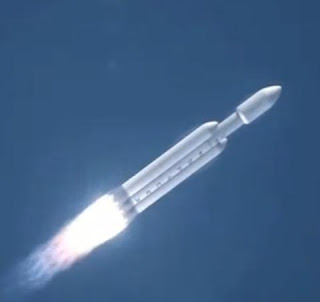 Are launch costs too high and weighing down your bottom line? Elon Musk, Space X founder, pitches his Falcon Heavy booster as right for the job to lift your prospects! In a Discovery News article, Musk says, "...we can realistically start to contemplate missions like a Mars sample return, which requires a tremendous amount of lift capability because you have to send a lander to Mars that still has enough propellant to return to Earth." Planetary Science Blog notes, the Falcon Heavy is second only to the Saturn V rocket in payload and escape velocity. The article adds 20-25 percent of mission cost is in the launch and idea of lowering your costs from $10,000 to $1,000 per pound a major selling point! A debut flight is scheduled for Vandenberg AFB in 2013. You can visit the Falcon Heavy webpage at the Space X website for more details. The sales pitch is a familiar one--"more bang for the buck"-- but will bottomline decisions translate into space exploration success? Do you trust companies and corporations to do the right thing in space?
Subscribe to:
Posts (Atom)