Pages

Showing posts with label voyager. Show all posts

Sunday, April 8, 2012

Local Space Weather: Local Cloud, Local Bubble and Giant Ribbon

Local Space Weather:  Local Cloud, Local Bubble and Giant Ribbon
Zen Gardner captures imagination and admiration in attempt to provide us with  comprehensive "local space weather" in post, "Is NASA Tracking The Cosmic Shift?" It may be difficult to visualize mentally space weather the Solar System is currently passing, so concise description from article works well:
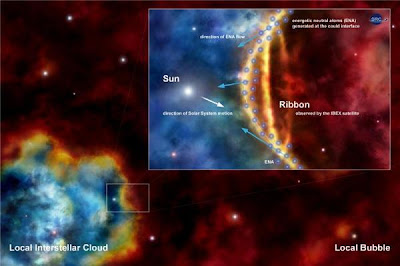
"'The Sun traveling through the Galaxy happens to cross at the present time a blob of gas about ten light-years across, with a temperature of 6-7 thousand degrees kelvin. This so-called Local Interstellar Cloud is immersed in a much larger expanse of a million-degree hot gas, named the Local Bubble. The energetic neutral atoms (ENA) are generated by charge exchange at the interface between the two gaseous media. ENA can be observed provided the Sun is close enough to the interface. The apparent Ribbon of ENA discovered by the IBEX satellite can be explained by a geometric effect: one observes many more ENA by looking along a line-of-sight almost tangent to the interface than by looking in the perpendicular direction.'"

Gardner putting it together cites NASA source, "Mystery of the Giant Ribbon Solved," an excerpt follows:
"The IBEX data fit in nicely with recent results from Voyager. Voyager 1 and 2 are near the edge of the solar system and they also have sensed strong magnetism nearby. Voyager measurements are relatively local to the spacecraft, however. IBEX is filling in the “big picture.” The ribbon it sees is vast and stretches almost all the way across the sky, suggesting that the magnetic field behind it must be equally vast."
A reader wonders if interaction will increase at Solar System's edge? How much more will magnetic field emanating from Local Cloud impinge upon the Heliosphere? Gardner asks, in turn, the obvious, "Is the Sun going to enter soon a million-degree galactic cloud of interstellar gas?" It's an excellent attempt by Zen Gardner to build upon individual reports to see greater implications of space weather - hats off!

Sunday, May 1, 2011

voyager adventure in three minutes

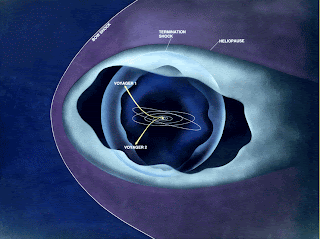
voyager adventure in three minutesA wonderful three minute NASA video provides story of Voyager spacecraft launched in 1977, a link provided via article at Universe Today. The video celebrates contributions made by the two craft as they near Interstellar Space. Ed Stone, California Institute of Technology in Pasadena, a Voyager Project Scientist, estimates in an article at NASA website, "...heliosheath is 3 to 4 billion miles in thickness...[which]...means we'll be out within five years or so...In many ways, the heliosheath is not like our models predicted".

The video and article relate details of Golden Record, "The Sounds of Earth". "Each probe is famously equipped with a Golden Record, literally, a gold-coated copper phonograph record. It contains 118 photographs of Earth; 90 minutes of the world's greatest music; an audio essay entitled Sounds of Earth (featuring everything from burbling mud pots to barking dogs to a roaring Saturn 5 liftoff); greetings in 55 human languages and one whale language; the brain waves of a young woman in love; and salutations from the secretary general of the United Nations. A team led by Carl Sagan assembled the record as a message to possible extraterrestrial civilizations that might encounter the spacecraft." You can only imagine what the record would bring at auction? It's an interesting story to revisit 33 years later!

Friday, December 31, 2010

mystery hexagon of saturn

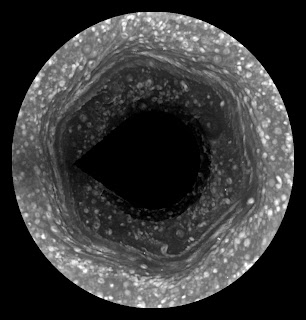
mystery hexagon of saturn In 1979, as Voyager 1 passed by Saturn, the satellite returned pictures of a hexagon on Saturn's North Pole.  The Cassini spacecraft confirmed, in 2006, the hexagon is still there! A brief You Tube video, "The Mystery Hexagon of Saturn" provides a fascinating look in less than two minutes. Discovery News provides a brief article and video, "Saturn's North Pole Hexagon Mystery Solved?", where a hexagon is achieved in laboratory conditions, supporting the notion this is indeed a natural phenomenon.

Tuesday, December 14, 2010

voyager 1 nears interstellar space

voyager 1 nears interstellar spaceUniverse Today reports Voyager 1, launched on Sept. 5 1977, has reached a point in outer space where there is no solar wind.  The solar wind has measured zero since June, when Voyager was 10.6 billion miles from the Sun.  The solar wind has turned the corner,” said Ed Stone, Voyager project scientist based at the California Institute of Technology in Pasadena, Calif. “Voyager 1 is getting close to interstellar space.” Voyager 1 has reached the boundary of the solar system, scientists believe the satellite will cross from the heliosphere and enter interstellar space in about 4 years.