Showing posts with label solar wind. Show all posts
Showing posts with label solar wind. Show all posts
Monday, August 15, 2011
black rain: nasa stereo mission images

Friday, February 25, 2011
sdo video of solar flare in super hi-def
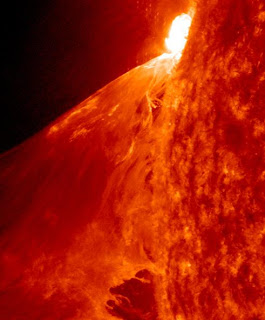 On February 24, 2011, Solar Dynamics Observatory (SDO) spacecraft captured magnificent stream of images, at 24 second intervals, to make a nearly flawless 17 second video here. A wave of erupting plasma as seen in high-def from a M3.6 class flare--never looked so good! It's pure eye candy. SDO launched from Cape Canaveral on Feb. 11, 2010 to study solar irradiance, the heliosphere and the solar wind on a mission expected to last over five years.
Tuesday, December 14, 2010
voyager 1 nears interstellar space
 Universe Today reports Voyager 1, launched on Sept. 5 1977, has reached a point in outer space where there is no solar wind. The solar wind has measured zero since June, when Voyager was 10.6 billion miles from the Sun. “The solar wind has turned the corner,” said Ed Stone, Voyager project scientist based at the California Institute of Technology in Pasadena, Calif. “Voyager 1 is getting close to interstellar space.” Voyager 1 has reached the boundary of the solar system, scientists believe the satellite will cross from the heliosphere and enter interstellar space in about 4 years.
Subscribe to:
Posts (Atom)