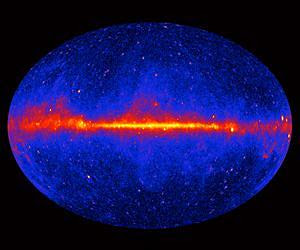
from spacedaily.com: Astronomers using data from NASA's Fermi Gamma-ray Space Telescope have made the most accurate measurement of starlight in the universe and used it to establish the total amount of light from all of the stars that have ever shone, accomplishing a primary mission goal.
"The optical and ultraviolet light from stars continues to travel throughout the universe even after the stars cease to shine, and this creates a fossil radiation field we can explore using gamma rays from distant sources," said lead scientist Marco Ajello, a postdoctoral researcher at the Kavli Institute for Particle Astrophysics and Cosmology at Stanford University in California and the Space Sciences Laboratory at the University of California at Berkeley.
Gamma rays are the most energetic form of light. Since Fermi's launch in 2008, its Large Area Telescope (LAT) observes the entire sky in high-energy gamma rays every three hours, creating the most detailed map of the universe ever known at these energies.
Showing posts with label gamma rays. Show all posts
Sunday, November 4, 2012
Fermi Measures Cosmic 'Fog' Produced by Ancient Starlight
Labels:
fermi space telescope,
gamma rays,
nasa
Saturday, December 17, 2011
tgfs: terrestrial gamma-ray flashes
Images (pictured) of gamma rays flashes from thunderstorm, captured by Fermi space telescope. Scientists believe this may occur up to 500 times daily. The Daily Galaxy article explains, "a space telescope has accidentally spotted thunderstorms on Earth producing beams of antimatter. Such storms have long been known to give rise to fleeting sparks of light called terrestrial gamma-ray flashes. But results from the Fermi telescope show they also give out streams of electrons and their antimatter counterparts, positrons." A YouTube video from NASA, "Terrestrial Gamma-ray Flashes Create Antimatter," is rewarding three minutes.
Labels:
antimatter,
fermi space telescope,
gamma rays,
nasa,
positron,
terrestrail gamma-ray flash,
tgf,
video
Sunday, November 28, 2010
the emp threat
"EMP Threat: fact, fiction and response", an article by Yousaf Butt at The Space Review, examines the threat of a catastrophic electromagnetic pulse. The present writer finds, in recent years, attention to this issue noteworthy. "Report of the Commission to Assess the Threat to the United States from Electromagntic Pulse (EMP) Attack", published in 2004, provides the recommendations of an EMP Commission. Butt's Space Review article addresses the commission's concerns about damage to the infrastructure, electronics and reviews results of high altitude nuclear explosions from 1955-62. The US series of tests called Starfish Prime and Russian series, which includedTest 184, are specifically reviewed.Butt breaks down three properties of a gamma ray burst from nuclear detonation and resultant pulse: E(1-3). E-1 and E-3 are most damaging to electronics, while properties of E-2 resemble lightning. A terrorist group could detonate a low yield nuclear device at an altitude of 40 to 100 km, which would be crippling to a nation's infrastructure and electronics. A low yield device would result in a pulse low in E-3 but still deliver sufficient E-1 energy to prove damaging. Today's electronics based on integrated circuits are one million times more vulnerable to pulse damage than the vacuum tubes used in the cold war era at the time of the high altitude nuclear detonations.
Subscribe to:
Posts (Atom)

