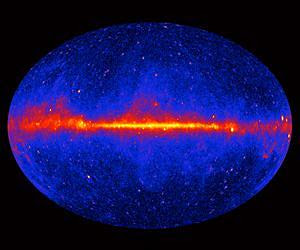
from spacedaily.com: Astronomers using data from NASA's Fermi Gamma-ray Space Telescope have made the most accurate measurement of starlight in the universe and used it to establish the total amount of light from all of the stars that have ever shone, accomplishing a primary mission goal.
"The optical and ultraviolet light from stars continues to travel throughout the universe even after the stars cease to shine, and this creates a fossil radiation field we can explore using gamma rays from distant sources," said lead scientist Marco Ajello, a postdoctoral researcher at the Kavli Institute for Particle Astrophysics and Cosmology at Stanford University in California and the Space Sciences Laboratory at the University of California at Berkeley.
Gamma rays are the most energetic form of light. Since Fermi's launch in 2008, its Large Area Telescope (LAT) observes the entire sky in high-energy gamma rays every three hours, creating the most detailed map of the universe ever known at these energies.
Showing posts with label fermi space telescope. Show all posts
Sunday, November 4, 2012
Fermi Measures Cosmic 'Fog' Produced by Ancient Starlight
Labels:
fermi space telescope,
gamma rays,
nasa
Tuesday, June 12, 2012
March 7 Solar Flare Emitted Highest Energy Light Ever Detected
The Sun is approaching Solar Maximum, expected to occur in 2013. Was March 7th X5.4 solar flare an indication of things to come? "During a powerful solar blast in March, NASA's Fermi Gamma-ray Space Telescope detected the highest-energy light ever associated with an eruption on the sun," states the video summary. "The powerful March 7 flare... is the strongest eruption so far observed by Fermi's LAT [Large Area Telescope]. The flare produced such an outpouring of gamma rays - a form of light with even greater energy than X-rays... At the flare's peak, the LAT detected gamma rays with two billion times the energy of visible light, or about 4 billion electron volts (GeV), easily setting a record for the highest-energy light ever detected during or just after a solar flare. The flux of high-energy gamma rays, defined as those with energies beyond 100 million electron volts (MeV), was 1,000 times greater than the sun's steady output... The March 7 flare also is notable for the persistence of its gamma-ray emission. Fermi's LAT detected high-energy gamma rays for about 20 hours, two and a half times longer than any event on record... Solar eruptions are now on the rise as the sun progresses toward the peak of its roughly 11-year-long activity cycle, now expected in mid-2013." Is this just the beginning of an unimaginable increase in solar activity?
Labels:
fermi space telescope,
solar flare,
solar maximum,
video
Friday, December 23, 2011
scud watching from geostationary earth orbit
Mad Scientists at DARPA are excited about prospects for Membrane Optic Imager Real-Time Exploitation (MOIRE) program. "MOIRE will park in space over the earth, and once there will unleash a "micron-thin diffractive-optics membrane" to form a 65-foot super-thin lens to watch a wider swath of ground more closely than anything else before," according to Business Insider. The super-thin membrane lens will "scrutinize an area about 62-miles in diameter; updating its video at about one frame per second, offering a 99 percent likelihood of catching a [SCUD] missile launch." Ball Aerospace has been awarded contract by DARPA to develop MOIRE tech, an Aviation Week article provides more details about technology. The space telescope will cost about $500 million a copy! A SCUD-watch impresses as a suspect cover story! The real question - what else will be scrutinized?
Labels:
darpa,
fermi space telescope,
moire,
technology
Saturday, December 17, 2011
tgfs: terrestrial gamma-ray flashes
Images (pictured) of gamma rays flashes from thunderstorm, captured by Fermi space telescope. Scientists believe this may occur up to 500 times daily. The Daily Galaxy article explains, "a space telescope has accidentally spotted thunderstorms on Earth producing beams of antimatter. Such storms have long been known to give rise to fleeting sparks of light called terrestrial gamma-ray flashes. But results from the Fermi telescope show they also give out streams of electrons and their antimatter counterparts, positrons." A YouTube video from NASA, "Terrestrial Gamma-ray Flashes Create Antimatter," is rewarding three minutes.
Labels:
antimatter,
fermi space telescope,
gamma rays,
nasa,
positron,
terrestrail gamma-ray flash,
tgf,
video
Subscribe to:
Posts (Atom)


