 4 Vesta appears to be only a rock to most of us, it's still an appreciable body not far in relative terms. Vesta orbits at a distance of 156, 000,000 miles from Earth in asteroid belt between Mars and Jupiter. Dawn spacecraft orbited Vesta for a year to learn more about our solar system. Five new discoveries are reported, as a result, in recent Universe Today article. It was over 200 years ago, "when Heinrich Wilhelm Olbers first glimpsed Vesta on March 29, 1807 — this date in history — the asteroid was but a small point of light. Asteroid science was very, very new at the time as the first asteroid (Ceres) had been discovered only six years before," begins article. The five surprising observations made about the heavenly body: 1) Vesta dirt is "well-mixed and mobile," lending smooth appearance to surface, 2) stretch marks apparent around asteroid's equator, may be due to a large impact, causing layers to separate inside asteroid and surface expansion, 3) "'Vesta is a transitional body between a small asteroid and a planet and is unique in many ways,' said mission scientist Vishnu Reddy of the Max Planck Institute for Solar System Research in Katlenburg-Lindau, Germany. 'We do not know why Vesta is so special,'" 4) hydrogen discovered near equator possibly delivered to asteroid by impacts with meteors or comets, and 5) northern and southern hemispheres look completely different. "'The northern hemisphere is older and heavily cratered in contrast to the brighter southern hemisphere where the texture is more smooth and there are lots of sets of grooves. There is a massive mountain at the South Pole. One of the more surprising aspects is the set of deep equatorial troughs,' said Carol Raymond, Dawn deputy principal investigator, of NASA’s Jet Propulsion Laboratory, Pasadena, Calif."
Showing posts with label vesta. Show all posts
Showing posts with label vesta. Show all posts
Friday, March 29, 2013
5 Weird Things About Vesta
4 Vesta appears to be only a rock to most of us, it's still an appreciable body not far in relative terms. Vesta orbits at a distance of 156, 000,000 miles from Earth in asteroid belt between Mars and Jupiter. Dawn spacecraft orbited Vesta for a year to learn more about our solar system. Five new discoveries are reported, as a result, in recent Universe Today article. It was over 200 years ago, "when Heinrich Wilhelm Olbers first glimpsed Vesta on March 29, 1807 — this date in history — the asteroid was but a small point of light. Asteroid science was very, very new at the time as the first asteroid (Ceres) had been discovered only six years before," begins article. The five surprising observations made about the heavenly body: 1) Vesta dirt is "well-mixed and mobile," lending smooth appearance to surface, 2) stretch marks apparent around asteroid's equator, may be due to a large impact, causing layers to separate inside asteroid and surface expansion, 3) "'Vesta is a transitional body between a small asteroid and a planet and is unique in many ways,' said mission scientist Vishnu Reddy of the Max Planck Institute for Solar System Research in Katlenburg-Lindau, Germany. 'We do not know why Vesta is so special,'" 4) hydrogen discovered near equator possibly delivered to asteroid by impacts with meteors or comets, and 5) northern and southern hemispheres look completely different. "'The northern hemisphere is older and heavily cratered in contrast to the brighter southern hemisphere where the texture is more smooth and there are lots of sets of grooves. There is a massive mountain at the South Pole. One of the more surprising aspects is the set of deep equatorial troughs,' said Carol Raymond, Dawn deputy principal investigator, of NASA’s Jet Propulsion Laboratory, Pasadena, Calif."

Wednesday, August 22, 2012
Dawn Departs Asteroid Vesta Sept 4 for Dwarf Planet Ceres
Dawn spacecraft departs Sept 4th from asteroid Vesta for dwarf planet Ceres. Dawn will skip some final low res. pix due to reaction wheel problem spacecraft experienced previously. Dawn mission scheduled to reach Ceres in February 2015 and end of primary mission slated for July 2015? Why an entire year orbiting a rock while less than half that time around an orb composed of up to 25% water? Where does Dawn venture after July 2015? Does spacecraft stay at Ceres and go offline?
Monday, November 7, 2011
dawn mission update: vesta no longer fuzzy blob
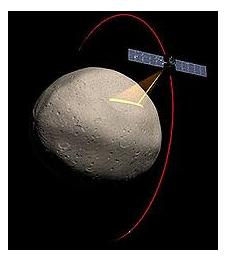 Dawn spacecraft spent past month mapping asteroid 4 Vesta in a 420 mile High Altitude Mapping Orbit (HAMO). An article at Space Daily, "Dawn Journal for October," reveals successful phase of mission completed while the probe, "..has spent most of its time over the illuminated side taking pictures and other scientific measurements and most of the time over the dark side beaming its precious findings back to eager Earthlings...Dawn revolves in a polar orbit around Vesta, passing above the north pole, then traveling over the day side to the south pole, and then soaring north over the night side. Each circuit takes 12.3 hours. Meanwhile, Vesta completes a rotation on its axis every 5.3 hours." The spacecraft has captured more than 7000 images. The northern pole of Vesta, presently in darkness, awaits mapping in a Low Altitude Mapping Orbit (LAMO). The present writer asks where is Richard C Hoagland? Hoagland believes there's "geometric evidence" of ruins on Vesta, discussed a few months ago on Coast to Coast AM! Vesta has remained little more than a fuzzy blob for over 200 years ago, since Heinrich Wilhelm Olbers' discovery in 1807. The Dawn mission has turned our view of Vesta into crystal clarity in a very short time, indeed. Any evidence of geometric anomalies on Vesta's surface will be awaited with much anticipation!
Sunday, September 25, 2011
asteroid 4 vesta: factoids and vestoids
 Asteroid 4 Vesta is the brightest object in the Asteroid belt, sometimes, viewable with the naked eye. German Astronomer Heinrich Olbers discovered Vesta, on March 29, 1807, the fourth "minor planet" as they were called to be detected after Ceres, Pallas and Juno. Olbers gave honor of naming Vesta to mathematician Carl Friedrich Gauss. In mythology, Vesta is goddess of the hearth and sister to Ceres.
Vesta has a differentiated interior with a crust and mantle, as a result, classified a protoplanet. The asteroid's dark regions reveal basaltic areas a direct result of lava flow. Astronomers believe Vesta's close proximity to Jupiter and the giant neighbor's gravitational pull, possibly, prevented further development into a full planet.
Vesta is surrounded by small asteroids (Vestoids), possibly, due to a collision with another heavenly body as evidenced by the large crater at the asteroid's South Pole. Vestoids have reached Earth. Other Vesta factoids are listed below:
330 mile diameter
5 hour and 20 minute day and 3.6 year orbit around Sun.
over 200 million miles from the Sun
An excellent Space.com article provides more facts about Vesta and its formation. One last factoid: Richard C Hoagland believes Vesta also has ruins on it!
Thursday, July 14, 2011
rocks on the brain: dawn mission to enter vesta orbit soon
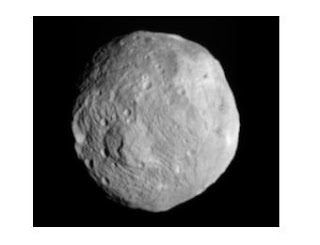 Do you think anyone that's interested in the Dawn mission at Vesta has rocks on their brain? How can anyone get worked up about a rock in the asteroid belt, you ask? You must wonder though: What might be discovered in the next year that Dawn orbits the asteroid? The latest NASA update on the Dawn Mission reports that "...the spacecraft to be captured into orbit at approximately 10 p.m. PDT Friday, July 15 (1 a.m. EDT Saturday, July 16)...When Vesta captures Dawn into its orbit, engineers estimate there will be approximately 9,900 miles (16,000 kilometers) between them." There could be the next monolith discovery or a sudden loss of the craft by a rapidly approaching UFO? The Dawn Mission is to provide answers to questions about the formation of our solar system. You have to wonder what else they have in mind - you just never know and it's a reason to keep track!
Sunday, May 22, 2011
dawn closing in on vesta
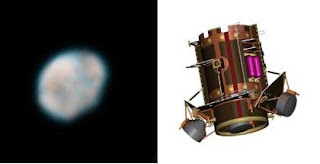 Mission enters exciting phase as Dawn spacecraft closes in on brightest object in asteroid belt, Vesta. The image of Vesta (pictured) is from Hubble telescope, but according to Emily Ladawalla at The Planetary Blog, "By early June, Dawn's images will be higher-resolution than anything achieved from Hubble." A nice mission update with Marc Rayman provided at Planetary Radio. The lastest blog entry at Marc Rayman's Dawn Journal details approach phase to the giant asteroid. "It's a big place," according to Rayman.
Subscribe to:
Posts (Atom)