Pages

Showing posts with label super-rotation. Show all posts

Tuesday, March 26, 2013

Venus's South Pole Vortex = Whirlwind Size of Europe

Venus's South Pole Vortex = Whirlwind Size of Europe
You may view astronomy boring, but south pole vortex of Venus may change your mind? The present writer prefers 2006 image (picture), when double vortex appeared. The picture revealed  Earth-like hurricane funnels.  A prior post on Venus south pole vortex, is available here.   In current article, "Venus's South Pole Vortex --Strange Behavior of a Whirlwind the Size of Europe," The Daily Galaxy reports:
"The astronomers in the UPV/EHU’s Planetary Science Group have completed a study of the atmospheric vortex of the south pole of Venus, a huge whirlwind the size of Europe similar to Jupiter's 300-year-old Great Red Spot and the South Pole Vortex on Saturn. In the atmosphere there are two main cloud layers separated by a distance of 20km. The astronomers have been closely monitoring the move- ment of the vortex on both levels, and have been able to confirm the erratic nature of this movement."
What did the research group find?

“We knew it was a long-term vortex; we also knew that it changes shape every day. But we thought that the centres of the vortex at different altitudes formed only a single tube, but that is not so...," concluded  Itziar Garate-Lopez, head researcher of the Planetary Science Group. The article summarizes mysterious atmospheric phenomena at Venus south pole below:
"The centers of rotation of the upper and lower vortex rarely coincide in their position with respect to the vertical, yet they form a constantly evolving permanent structure on the surface of Venus. Long-term vortices are a frequent phenomenon in the atmospheres of fast rotating planets, like Jupiter and Saturn, for example. Venus rotates slowly, yet it has permanent vortices in its atmosphere at both poles. What is more, the rotation speed of the atmosphere is much greater than that of the planet."
  "'We’ve known for a long time that the atmosphere of Venus rotates 60 times faster than the planet itself, but we didn’t know why,' says Garate-Lopez. 'The difference is huge; that is why it’s called super-rotation. And we‘ve no idea how it started or how it keeps going.'" Super-rotation remains fascinating phenomenon, although atmospheric gases may lie at heart of mystery?

Monday, November 19, 2012

Arc of Venus: Mysteries of Our Sister Planet's Atmosphere

Arc of Venus: Mysteries of Our Sister Planet's Atmosphere
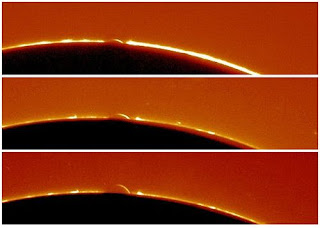
The Daily Galaxy shares scientists strategy to better understand atmosphere of Venus.  The biggest Venus mystery concerns, according to article, "...super-rotation. The whole atmosphere circles the planet in just four Earth days, much faster than the planet's spin period of 243 days."  Refracted sunlight as it passes through layers of air above planet's cloudtops, creates an arc of light.   "The brightness of the arc reveals the temperature and density structure of Venus's middle atmosphere, or 'mesosphere,' where the sunlight is refracted. According to some models, the mesosphere is key to the physics of super-rotation. By analyzing the lightcurve of the arc, researchers can figure out the temperature and density of this critical layer from pole to pole,"  reports article.  It's difficult to imagine world. where it revolves only once every 243 days but the weather circles the globe every four?  Will scientists figure out physics of  super-rotation of Venus atmosphere?