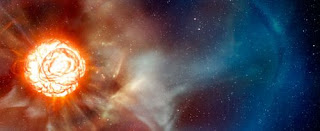
Betelgeuse, a red giant, is in the constellation Orion, one of the brightest stars in the night sky. A recent Daily Galaxy article reports the Red Super Giant, shrunk by 15 per cent over the last 15 years. "Red giant stars are thought to have short, complicated and violent lifespans. Lasting at most a few million years, they quickly burn out their hydrogen fuel and then switch to helium, carbon and other elements in a series of partial collapses, refuelings and restarts. Betelgeuse, which is thought to be reaching the end of its lifespan, may be experiencing one of those collapses as it switches from one element to another as nuclear-fusion fuel," explains article. The above image was obtained by "...using different state-of-the-art techniques on ESO's Very Large Telescope, two independent teams of astronomers obtained the sharpest ever views of the supergiant star Betelgeuse. They show that the star has a vast plume of gas almost as large as our Solar System and a gigantic bubble boiling on its surface. These discoveries provide important clues to help explain how these mammoths shed material at such a tremendous rate."
A core collapse is thought to precede a star burst into Supernova and according to article, "Betelgeuse... could burst into its supernova phase and become as bright as a full moon - and last for as long as a year." Betelgeuse is 600 light years from Earth. We'll just have to wait and see, but don't stay up too long, it may not happen for 100,000 years!
Showing posts with label red giant. Show all posts
Tuesday, June 19, 2012
Betelgeuse: Red Giant to Burst into Supernova?
Labels:
betelgeuse,
red giant,
supernova
Friday, December 2, 2011
sunscare: scientists worry more than solar minimum at hand
Is it only fear-mongering over new observations in article at Before It's News, "Shocked Scientists Ask: Is the Sun Dying?" The solar system is, after all, coursing through relatively unknown region of the galactic ecliptic and sun may be affected in unpredictable ways? The article is, still, of great interest as a regional space weather report, offering a sort of local forecast! Scientists concerns are threefold: 1) sun's core of hydrogen gases is shrinking, and presents concern, helium gases will be used instead as fuel. Helium would transform Sun into a Red giant. Scientists believed, previously, this phase of Sun's lifespan still billions of years in future.
2) The Sun has been cooling since 1979. Scientists were shaken when a predicted warming trend did not materialize in 2007. The cooling trend is drawing comparisons to the Maunder Minimum, a mini-ice age of the late 1700s. David Hathaway of the Marshall Space Flight Center in Huntsville, AL sums up agreement among scientists in Scientific American article, "I think we're almost in violent agreement that this is an interesting minimum". The Sun's so-called "Great Conveyor Belt" has slowed to a crawl, which affects future solar activity. The solar wind, is also, 13 percent cooler and 20 percent less dense. The Sun's heliosphere is shrinking, offering less protection from Cosmic rays.
Perhaps, most alarmist of all, 3) Scientists are concerned about radioactive decay rates speeding up and possibility matter itself is being mutated? Wow! The article concludes with a fitting description and picture of a solar system without its first four planets, vaporized by our Red giant Sun! The present writer believes most readers suffer a degree of fear-fatigue and take a flamethrower in their face to get their attention! It's still a very interesting read!
2) The Sun has been cooling since 1979. Scientists were shaken when a predicted warming trend did not materialize in 2007. The cooling trend is drawing comparisons to the Maunder Minimum, a mini-ice age of the late 1700s. David Hathaway of the Marshall Space Flight Center in Huntsville, AL sums up agreement among scientists in Scientific American article, "I think we're almost in violent agreement that this is an interesting minimum". The Sun's so-called "Great Conveyor Belt" has slowed to a crawl, which affects future solar activity. The solar wind, is also, 13 percent cooler and 20 percent less dense. The Sun's heliosphere is shrinking, offering less protection from Cosmic rays.
Perhaps, most alarmist of all, 3) Scientists are concerned about radioactive decay rates speeding up and possibility matter itself is being mutated? Wow! The article concludes with a fitting description and picture of a solar system without its first four planets, vaporized by our Red giant Sun! The present writer believes most readers suffer a degree of fear-fatigue and take a flamethrower in their face to get their attention! It's still a very interesting read!
Labels:
cosmic rays,
great conveyor belt,
maunder minimum,
red giant,
solar minimum,
sun
Subscribe to:
Posts (Atom)

