
Showing posts with label music. Show all posts
Showing posts with label music. Show all posts
Monday, November 5, 2012
Fight Growing Over Online Royalties

Wednesday, August 29, 2012
Will.i.am's New Single Debuts On #Mars
Establishment Shill Rewarded for #Obamessiah, #ClimateControl Work*
from latimesblogs.latimes.com: For will.i.am, what started as a fascination with space turned into a history-making song that was transmitted earlier this week from the Mars rover Curiosity... Times Science Writer Amina Khan discussed how will.i.am came to write the song and how NASA came to use the music as part of the Mars mission. “There’s no words to explain how amazing this is,” the singer, of Black Eyed Peas fame, said to the gathered audience, standing on stage with NASA astronaut Leland Melvin, the agency’s associate administrator for education. The song, called “Reach for the Stars,” was beamed back to the Jet Propulsion Laboratory in La Cañada Flintridge, where will.i.am took the stage to answer questions from students from Boyle Heights, where he grew up. The song features a 40-piece orchestra and isn’t your standard urban hip-hop anthem, the singer pointed out, because it’s meant to weather the test of time and be easily translated across cultures. “I know that Mars might be far, but baby it ain’t really that far / Let’s reach for the stars (reach for the stars),” will.i.am sings on the track.
from latimesblogs.latimes.com: For will.i.am, what started as a fascination with space turned into a history-making song that was transmitted earlier this week from the Mars rover Curiosity... Times Science Writer Amina Khan discussed how will.i.am came to write the song and how NASA came to use the music as part of the Mars mission. “There’s no words to explain how amazing this is,” the singer, of Black Eyed Peas fame, said to the gathered audience, standing on stage with NASA astronaut Leland Melvin, the agency’s associate administrator for education. The song, called “Reach for the Stars,” was beamed back to the Jet Propulsion Laboratory in La Cañada Flintridge, where will.i.am took the stage to answer questions from students from Boyle Heights, where he grew up. The song features a 40-piece orchestra and isn’t your standard urban hip-hop anthem, the singer pointed out, because it’s meant to weather the test of time and be easily translated across cultures. “I know that Mars might be far, but baby it ain’t really that far / Let’s reach for the stars (reach for the stars),” will.i.am sings on the track.
Thursday, July 5, 2012
#DataDump: God Particle, Predictive Programming and more
CERN Physicists Claim Evidence of Higgs-Boson*
Video: What is a Higgs Boson? -
Physicist Michio Kaku Responds*
Theorist Peter Higgs lives to see his boson*
Video: Alan Alda's '#Flame Challenge' Illuminates Importance of Communicating #Science*
Life Imitating Art: Robot Avatar Body Controlled By Thought*
Video: Proof That 'Predictive Programming' Works*
DNSChanger Could Leave Thousands Stranded When Domains Go Dark on Monday*
Government Demands Growing for Twitter User Data*
L.A. Cops Embrace Crime-Predicting Algorithm*
Video: Dan Bull "Death of ACTA"*
Video: What is a Higgs Boson? -
Physicist Michio Kaku Responds*
Theorist Peter Higgs lives to see his boson*
Video: Alan Alda's '#Flame Challenge' Illuminates Importance of Communicating #Science*
Life Imitating Art: Robot Avatar Body Controlled By Thought*
Video: Proof That 'Predictive Programming' Works*
DNSChanger Could Leave Thousands Stranded When Domains Go Dark on Monday*
Government Demands Growing for Twitter User Data*
L.A. Cops Embrace Crime-Predicting Algorithm*
Video: Dan Bull "Death of ACTA"*
Saturday, April 28, 2012
Sci-Fi Cult Classic: 'Robinson Crusoe on Mars'

Wednesday, March 21, 2012
In Sweden, Cash Is King No More

"There are towns where it isn't at all possible anymore to enter a bank and use cash," complains Curt Persson, chairman of Sweden's National Pensioners' Organization. He says that's a problem for elderly people in rural areas who don't have credit cards or don't know how to use them to withdraw cash. The decline of cash is noticeable even in houses of worship, like the Carl Gustaf Church in Karlshamn, southern Sweden, where Vicar Johan Tyrberg recently installed a card reader to make it easier for worshippers to make offerings. "People came up to me several times and said they didn't have cash but would still like to donate money," Tyrberg says.
Bills and coins represent only 3 percent of Sweden's economy, compared to an average of 9 percent in the eurozone and 7 percent in the U.S., according to the Bank for International Settlements, an umbrella organization for the world's central banks. Three percent is still too much if you ask Ulvaeus. A cashless society may seem like an odd cause for someone who made a fortune on "Money, Money, Money" and other ABBA hits, but for Ulvaeus it's a matter of security.
Thursday, September 29, 2011
9/29 defcon: cookies, retention & a heavenly palace
facebook tracks you even after logging out*
 australian tech expert discovers faCIAbook cookies*
facebook to form its own political action committee*
after outcry, onstar backing down on vehicle data collection*
'retention periods of major cellular service providers':
secret memo reveals verizon stores your data the longest*
state dept employee faces firing for posting wikileaks link*
manning & assange nominated for nobel peace prize*
video: anonymous hacktivists go hip-hop*
video: ice official who 'fights' child porn arrested for it*
sun unleashes two massive x-class solar flares*
earth in cross-hairs of huge solar storm caused by sunspot 1302?*
'heavenly palace 1': china set to launch its own space station; mission: unknown*

facebook to form its own political action committee*
after outcry, onstar backing down on vehicle data collection*
'retention periods of major cellular service providers':
secret memo reveals verizon stores your data the longest*
state dept employee faces firing for posting wikileaks link*
manning & assange nominated for nobel peace prize*
video: anonymous hacktivists go hip-hop*
video: ice official who 'fights' child porn arrested for it*
sun unleashes two massive x-class solar flares*
earth in cross-hairs of huge solar storm caused by sunspot 1302?*
'heavenly palace 1': china set to launch its own space station; mission: unknown*
Thursday, May 26, 2011
5/26 defcon: stuxnet, square & born this way
senior defense official squirms on US involvement in stuxnet*
 flashback: israel tested stuxnet at dimona*
senator blocks bill giving feds power to blacklist piracy sites*
brookings' darrell west: we don't need federal internet agency*
lady gaga fans crash amazon cloud for .99¢ album*
square tries to make wallets obsolete*
google faces lawsuit over mobile phone 'wallet'*
flashback: israel tested stuxnet at dimona* senator blocks bill giving feds power to blacklist piracy sites*
brookings' darrell west: we don't need federal internet agency*
lady gaga fans crash amazon cloud for .99¢ album*
square tries to make wallets obsolete*
google faces lawsuit over mobile phone 'wallet'*
Saturday, May 14, 2011
restored 'trip to the moon' debuts on cannes opening night
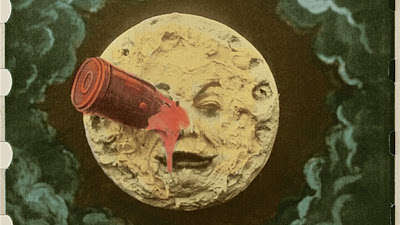 from hollywood reporter: Before CGI and 3D, there was French film pioneer Georges Melies, the forerunner of modern-day movie magic. His newly restored 1902 short A Trip to the Moon will precede Woody Allen’s Midnight in Paris to open up this year’s Cannes Film Festival. A must for any film student or special effects lover, the 14-minute space fantasy was adapted by Melies from the work of Jules Verne, and shot in a studio he built in the Paris suburb of Montreuil. Filled with dazzling set pieces and uncanny visual trickery, the most iconic being an image of a rocket ship poking into the moon’s eye, the movie went on to achieve instant success both in France and the U.S.
The massive restoration, budgeted at E400,000 and jointly financed by Serge Bromberg’s Lobster Films (Henri-George Clouzot’s Inferno), the Groupama Gan Foundation and the Technicolor Foundation, began in 1993 when a rare, hand-tinted print was uncovered in Barcelona. In 1999, Lobster began digitizing the footage frame by frame, and over ten years and 13,000 frames later, the film can now be seen in a full-blown color version for the first time since its debut more than a century ago. Although silent film purists may gasp at the restorers’ choice to add a catchy soundtrack by French electro duo Air (Lost in Translation), Moon should continue its voyage after Cannes to play plenty of fests and film museums before it lands on DVD.
Monday, April 4, 2011
2001: a concert odyssey blasts off in london
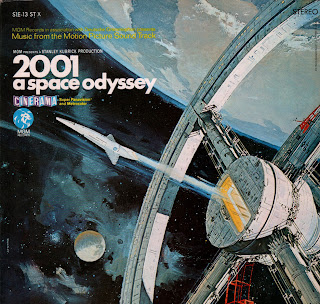 from reuters: Stanley Kubrick's "2001: A Space Odyssey" made the timpani intro of Richard Strauss's "Thus Sprach Zarathustra" a cliche for a dramatic entrance and the crescendo of Gyorgy Ligeti's "Atmospheres" a cult classic. Now fans of one of the most influential soundtracks of all time can hear it in sound that will out-Dolby Dolby for an ambitious programme at London's Southbank Centre that combines a new print of Kubrick's 1968 sci-fi masterpiece with a large chorus and full orchestra playing the film music live. "It's absolute goosebumps," said Gillian Moore, head of contemporary culture at Southbank, where two concert showings of "2001: A Space Odyssey" will be given next week (April 7 and 8). "It's like an opera," added German conductor Andre de Ridder, whose job it is to coordinate the massive forces of the orchestra and chorus with a film that was never meant, unlike some silent films, to have a live musical accompaniment. "I would say it is the perfect marriage of sound, theatre, drama and visual art," he added -- covering all the bases.
Sunday, December 5, 2010
what happened to telstar?
 Whatever happened to Telstar? The first communications satellite (COMSAT) to relay television signals launched from Cape Canaveral on July 10, 1962. A video of the launch can be viewed here. Telstar's Wikipedia entry reveals the COMSAT was a victim of the cold war. "The day before Telstar 1 was launched, the United States had tested a high-altitude nuclear bomb (called Starfish Prime) which energized the Earth's Van Allen Belt where Telstar 1 went into orbit. This vast increase in radiation, combined with subsequent high-altitude blasts, including a Soviet test in October, overwhelmed Telstar's fragile transistors..." The satellite went out of service permanently on February 21, 1963. The AT&T-owned satellite inspired The Tornados to a number one hit in the UK and the US also named after the satellite, 'Telstar'.
related update: 3 russian satellites crash in pacific near hawaii
Subscribe to:
Posts (Atom)