
Showing posts with label milky way. Show all posts
Showing posts with label milky way. Show all posts
Thursday, January 3, 2013
Milky Way's Core Source of Monster Energy Outflows

Wednesday, December 26, 2012
Our Milky Way
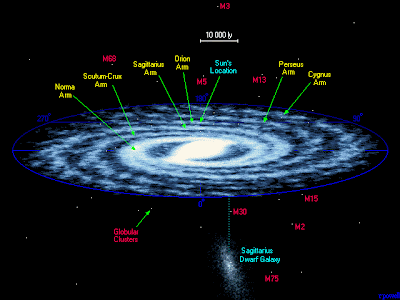
"The Milky Way is a giant, being average to large as galaxies go. It is 100,000 light years across, 1,000 light years thick, and with a circumference of between 250,000 to 300,000 light years. If you could see the Milky Way from deep space it would be as striking as any other, with two major spiral arms that encircle the nucleus in a graceful spiral structure. It is now thought that our Galaxy has a central bar that stretches 27,000 light years from end to end ...The two major spiral arms are connected to the ends of this central bar structure, and it is thought that the bars of such galaxies like our own act as a channel for dust, gas, and other interstellar material to get transported towards the core, eventually ending up in a super-massive black hole in the centre... the two main arms are the Scutum-Centaurus arm and the Perseus arm. The solar system is contained in a minor arm called the Orion-Cygnus arm. The Milky Way is thought to contain between 200 and 400 billion stars..."A galactic year is explained, in article, as time it takes our solar system to do one orbit of the galactic center. How long is it? A galactic year and our solar system orbit are described below:
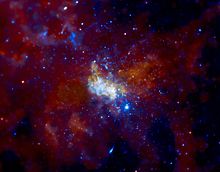
"Our Sun lies 24,000 to 26,000 light years out from the core, and orbits around the centre of the Galaxy. The Milky Way is so vast that the time it takes the solar system to do just one orbit of the Milky Way’s centre is 250 million years, this is known as a galactic year. The Sun has been in existence for 20 galactic years, so it has only done 20 orbits in all of its life so far...As the Sun and its planets travel around the galactic centre it does not just stay level as it makes its trek, it actually bobs up and down in the 1,000 light year thickness of the Galaxy’s plane. This up and down motion amounts to an oscillation of 3.7 times per orbit...As with all galaxies we also have a monster at the centre of ours, Sagittarius A is the name for the energetic region at the Galaxy’s core. This region is an intense radio source, it marks the centre of the Galaxy, and the motion of stars and material around it gives it away as an object of very large mass, a super massive black hole. This is a turbulent and dynamic area of bright star clusters, very hot gas, intense x-rays, and huge magnetic fields. The black hole at the centre of all this activity has a mass of 2.6 million to 4 million times the mass of our Sun."The Encyclopedia of Science supplies more information on our Milky Way.
Saturday, November 10, 2012
Sgr A* Shoots Brightest Flare Ever!
Subscribe to:
Posts (Atom)