"Mars hasn’t sprouted a nitrogen-and-oxygen atmosphere overnight. The image above is a crop from a panoramic mosaic made of images from NASA’s Curiosity rover, showing Gale crater’s central peak Mount Sharp (or Aeolis Mons, if you prefer the official moniker.) Don’t let the blue sky fool you though — the lighting has been adjusted to look like a sunlit scene on Earth, if only to let geologists more easily refer to their own experience when studying the Martian landscape."The present writer wonders? A prior post also shows blue Martian skies, "Martian Sky Is Blue."
Showing posts with label image. Show all posts
Friday, March 15, 2013
What Mount Sharp Would Look Like on Earth
Universe Today posts a fantasy what-if picture under title, "What Mount Sharp Would Look Like on Earth." Mt. Sharp, a three-mile high mount in Gale crater on Mars, appears under blue skies. The article reassures reader to avoid confusion below:
Saturday, October 13, 2012
Aqua Purple Aurora Captured Over Saskatoon, Saskatchewan
Colin Chatfield captures amazing Aurora today over Saskatoon, Saskatchewan, Canada! Spaceweather.com reports: "'This is from my backyard around 5:00a.m. this morning,' says Chatfield. 'Never have I seen the auroras so bright, especially from within the city. They were astounding, with purple visible to the naked eye .'" Thanks goes to Spaceweather.com for link also for supplying explanation behind this morning's aurora: "The source of the storm was a knot of south-pointing magnetism from the sun. The knot drifted past Earth, bumping into our own planet's magnetic field. This caused a crack to open in Earth's magnetic defenses. Solar wind poured in to fuel the auroras."
Monday, October 8, 2012
Auroras Treat Viewers On Oct 8th, 2012
NASA website reports: "...coronal mass ejection [CME] that erupted from the sun on Oct. 4, 2012 at 11:24 p.m. EDT arrived at Earth on Oct. 8 at 12:30 a.m. EDT, as observed by instruments aboard NASA's Advanced Composition Explorer (ACE) spacecraft." CME caused geomagnetic storms when it reached Earth's magnetosphere, resulting in Auroras. A description of Auroral mechanism at Wikipedia provides interesting details on different colors. Ray McKenzie captured image (picture) of awe-inspiring Aurora in early hours of Oct 8, 2012 in the skies over Saskatoon, Saskatchewan. More stunning Auroras captured for your viewing pleasure at Universe Today!
Monday, September 3, 2012
Aurora Over Whitehorse, Yukon On Sept 3
Thanks goes to SpaceWeather.com and Jonathan Tucker, who captured beautiful Aurora early today over Whitehorse, Yukon! The Sept. 3rd eye-blitz is result of C-8 Class Coronal Mass Ejection (CME) that erupted from southeastern region of Sun on August 31st. The CME sped towards Earth at quoted rate of 1.1 million mph and appears even faster than advertised? You may drop below fold for striking video of August 31st CME. It's all pure eye-candy! Wednesday, August 8, 2012
Mt Sharp: Postcard From Mars
Curiosity, NASA's latest Mars rover, successfully landed in Gale crater, earlier this week. The Mars rover already sent back a postcard perfect picture of Mt. Sharp (picture, left). Mt.Sharp rises 18,000 ft above Martian surface. A comparison provided (picture, right) shows Mt. Sharp would inspire if located on Earth as it towers higher than Mt. Rainier. The NASA team will learn to operate SUV-sized Mars rover for next 90 Martian days, according to WashPO story.
Labels:
curiosity,
gale crater,
image,
msl,
mt sharp
Sunday, March 11, 2012
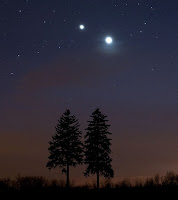
Venus and Jupiter Converging March 12 - 13
Venus and Jupiter will be less than 3 degrees apart in western sky just after sunset for next two evenings. The sight of converging globes can be a beautiful even mesmerizing sight. Thanks goes to Marek Nicoderm for image (pictured) from approach on March 9. You may view more images at SpaceWeather.com.
Sunday, October 30, 2011
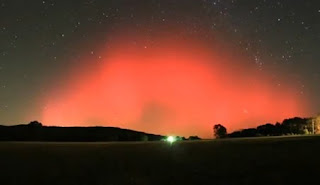
october 24 auroras seen in half of states
Auroras seen as far south as Arkansas on October 24 after solar flare hits Earth. The geomagnetic storms included rarely seen red auroras. This image is from Ozark, Arkansas, and according to Intel Hub: "these rare all-red auroras sometimes appear during intense geomagnetic storms. They occur some 300 to 500 km above Earth’s surface and are not yet fully understood."
Labels:
aurora,
image,
red aurora,
solar flare
Subscribe to:
Posts (Atom)